
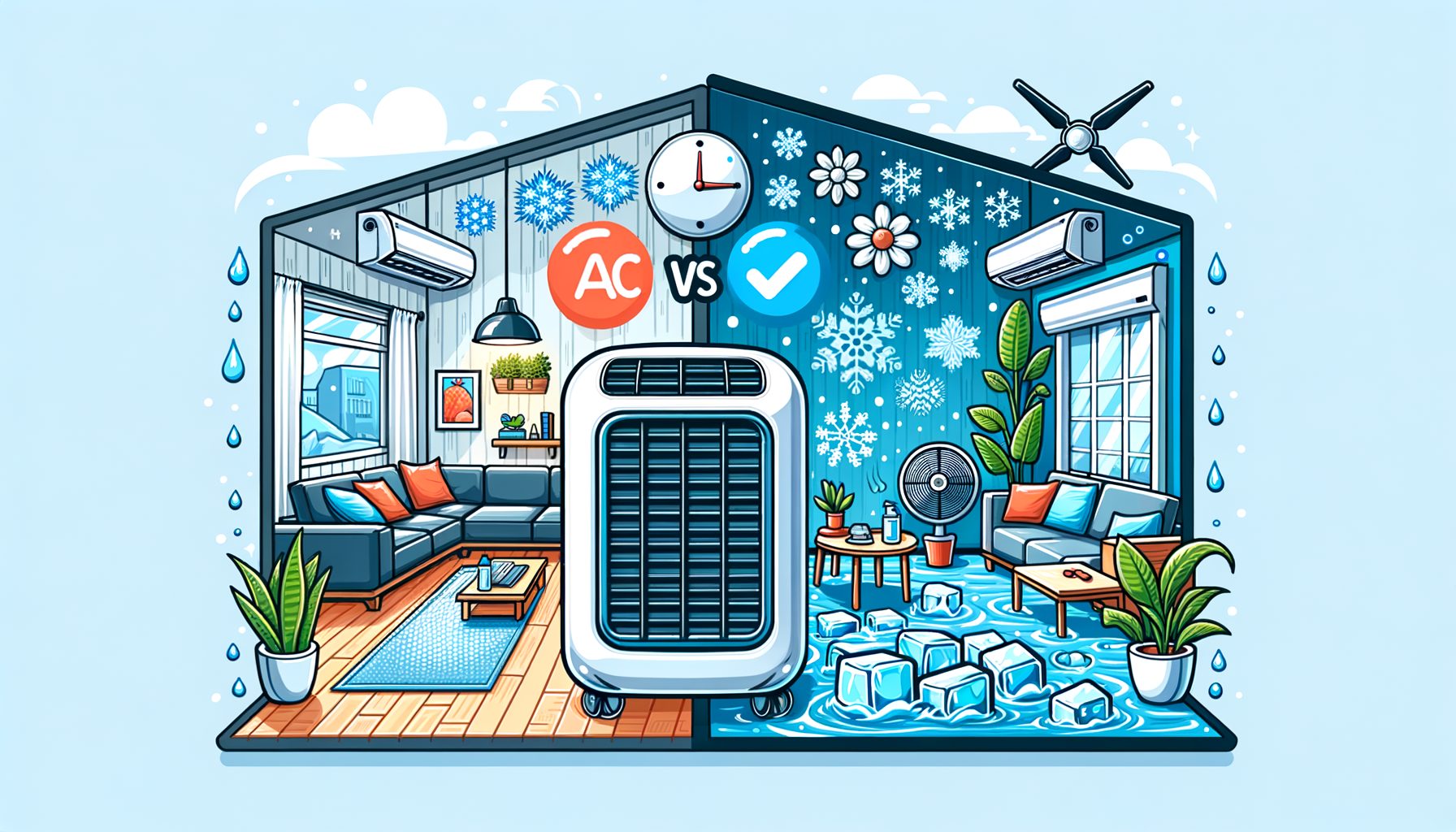
Heat waves are getting longer and more intense, and most of us want fast relief without wrecking our budget. Portable AC vs air cooler is the classic summer dilemma—pick strong, refrigerant-based cooling with higher power draw, or go for water-powered evaporative cooling that’s cheap to run but limited by humidity? In plain language, the guide below breaks down the real differences so you can stay cool, save money, and choose what fits both climate and home.
The Real Problem: Comfort, Cost, and Climate Don’t Always Match
The core question isn’t just “how do I cool my room?”—it’s “how do I get reliable comfort without burning cash or fighting my climate?” Traditional air conditioning extracts heat and moisture from indoor air, delivering a steady temperature drop even in muggy weather. Evaporative air coolers (often called swamp coolers) blow air across wet pads to evaporate water, which cools the air but adds humidity. Result: fantastic in dry regions—underwhelming in humid ones.
Many homes and apartments run into real-world constraints: no permission to install a window unit, limited electrical circuits, small windows or sliding doors, tight budgets, and concerns about energy use. Portable air conditioners ease some of these pain points with compressor-based cooling on wheels and a hose that vents hot air out a window or door. They’re powerful but can draw 700–1,400 watts or more. Air coolers often sip just 60–120 watts, yet their effectiveness can fall sharply if relative humidity climbs above roughly 50–60%. In short, your ZIP code or local climate can decide which option actually works.
Comfort is more than temperature. Humidity control affects sleep, productivity, and indoor air quality. AC dries the air (great for sticky nights, less ideal if your skin or throat dries easily). Air coolers raise humidity (perfect for desert air, problematic if your space is already damp). Noise matters too: both devices make sound, but the character differs—compressor hum versus fan whoosh. Maintenance varies as well: ACs need filters cleaned and condensate managed; air coolers require fresh water, pad care, and diligence to avoid musty odors.
So the real challenge is aligning three variables: your climate (dry vs. humid), your space (size, insulation, vent options), and your priorities (lowest running cost vs. strongest cooling). Get those right, and summer gets a lot easier.
Portable Air Conditioners: How They Work, What They Cost, and When They Shine
Portable AC units rely on a sealed refrigeration cycle—the same principle as a fridge. Warm indoor air passes over cold coils, heat is absorbed and pumped out through an exhaust hose, and moisture is condensed into water. Two big benefits are gained: consistent temperature drop and active dehumidification. That’s why portable ACs are the go-to for humid cities and heat waves where nights stay sticky.
Key terms help you shop smart. BTU or SACC (Seasonally Adjusted Cooling Capacity) describes cooling power; higher numbers mean stronger cooling. Single-hose units are simpler but can pull in warm air from other parts of your home; dual-hose designs usually perform better by separating intake and exhaust air. Expect power draw somewhere between 700 and 1,400 watts for most living-room-sized models, though inverter-style units can modulate power to reduce peaks and noise. For venting, you’ll need a window kit or a door/slider kit; performance improves when the seal is tight. Condensate may collect in a reservoir, drain via a hose, or be evaporated through the exhaust—check the manual for your model’s method.
Real-world performance hinges on correct sizing and setup. As a very rough starting point, small bedrooms may do well in the 8,000–10,000 BTU (or similar SACC) range, while larger living spaces may require 12,000–14,000. Insulation, sun exposure, ceiling height, and heat-producing electronics can all push your needs higher. On the fence? Choose higher SACC, a dual-hose design, and a high-efficiency (inverter) compressor. Doors should be kept closed, gaps around the window kit should be sealed, and sun-facing windows should be shaded to boost performance.
Costs are straightforward: higher upfront price than air coolers, and higher running costs. Well, here it is: at a typical residential electricity price of $0.20 per kWh, a 1,000-watt portable AC costs about $0.20 per hour to run. The trade-off is clear—reliable cooling in sticky weather and a drop in both temperature and humidity that can improve sleep and comfort. For renters, portability and no-permanent-install setups are a win. For health and safety, filters should be cleaned regularly and the exhaust hose kept kink-free with adequate airflow. For more on cooling efficiency and ratings, see the U.S. Department of Energy’s Energy Saver guidance at https://www.energy.gov/energysaver/room-air-conditioners.
Evaporative Air Coolers: Budget-Friendly Cooling With Climate Limits
Evaporative coolers pass air across wet pads so water can evaporate and cool the air. Simple physics explains it: evaporation absorbs heat, dropping the air temperature. The upside is huge efficiency. Many room coolers pull just 60–120 watts—often less than a laptop and far less than a portable AC. They also add moisture, making dry air feel more comfortable. Then this: performance depends on humidity. As humidity rises, evaporation slows, and cooling fades. In humid regions, a cooler may feel like a damp fan rather than true cooling.
Performance hinges on airflow (measured in CFM), pad design (honeycomb is common), and ventilation. Unlike AC, you typically want a window or door cracked open to push humid air out and draw drier air in. With proper cross-ventilation, you can get a pleasant, natural-feeling breeze and a noticeable temperature drop in dry climates. Water consumption varies by size and dryness; expect roughly 0.5–2.0 liters per hour for room models. If your tap water is hard, mineral “white dust” can appear; using filtered water reduces it. Pads should be cleaned or replaced regularly to avoid odors and maintain performance.
Evaporative coolers shine in desert and semi-arid regions and during shoulder seasons with low humidity. In places like Phoenix or parts of Northern India in pre-monsoon heat, an air cooler can feel amazing. In monsoon or coastal humidity, performance falls off quickly. Because they add moisture, they’re not ideal for closets, windowless bathrooms, or basements that already feel damp. For bedrooms, look for quiet fan modes and a sleep timer. For living rooms, match CFM to room size (as a broad rule of thumb for spot cooling, around 2–3 CFM per square foot of the area you want to feel breezy, though product guidance varies). Keep pads clean, empty the tank when not in use, and ensure fresh airflow for best results.
Running costs are minimal. At $0.20 per kWh, a 100-watt cooler costs about two cents per hour to run. There’s no refrigerant to worry about; the environmental footprint centers on electricity for the fan and water use. What’s interesting too: heat-health safety matters regardless of device. For advice, see the World Health Organization guidance at https://www.who.int/news-room/fact-sheets/detail/climate-change-heat-and-health.
Side-by-Side Comparison and a Practical Buying Checklist
The table below summarizes the most important differences between portable air conditioners and evaporative air coolers. Use it as a quick reference, then read the checklist to choose confidently.
| Factor | Portable Air Conditioner | Evaporative Air Cooler |
|---|---|---|
| Cooling method | Refrigeration (compressor) | Water evaporation (no compressor) |
| Climate fit | Works in dry or humid | Best when RH ≤ ~50%, dry climates |
| Typical power draw | 700–1,400 W | 60–120 W |
| Estimated cost/hour at $0.20/kWh | $0.14–$0.28 | $0.01–$0.03 |
| Humidity effect | Lowers humidity (dehumidifies) | Raises humidity |
| Setup | Requires vent to window/door | Needs open window/door for airflow |
| Maintenance | Clean filter; manage condensate | Refill tank; clean/replace pads |
| Noise character | Compressor + fan | Fan only |
| Price range (typical) | Higher upfront | Lower upfront |
| Environmental notes | Uses refrigerant (increasingly low-GWP like R-290) | No refrigerant; uses water |
Decision rule that covers 80% of cases: if you live in a humid area or nights feel sticky, choose a portable AC. If your climate is dry and you prefer low cost and a fresh-breeze feel, choose an evaporative cooler. Well, here it is: if you’re unsure, check local humidity during hot hours. If it’s often above 55–60% RH, air coolers will struggle.
Buying checklist you can follow today: measure your room (length × width × height); note sun exposure and insulation; confirm whether you can vent through a window or slider; and set your monthly energy budget. For portable AC, prioritize SACC/BTU appropriate for your space, dual-hose or inverter models for efficiency, a solid window kit, and washable filters. For air coolers, match CFM to the area you want to cool, look for thick honeycomb pads, a large tank for fewer refills, and a drain or easy-clean design. In both cases, verify noise levels if you’re sensitive, check wheel quality for mobility, and ensure the power cord reaches your outlet safely without daisy-chaining.
Quick scenario examples: a humid coastal apartment with a small bedroom and street-facing window? A compact, dual-hose portable AC with a good seal will keep you comfortable at night. A dry, high-altitude studio with cross-ventilation? A mid-size evaporative cooler with quality pads and a sleep timer can feel great while costing pennies per hour.
Q&A: Portable AC vs Air Coolers
Q1: Which is better in humid climates? Portable AC. It actively removes heat and moisture, keeping you comfortable even when outdoor humidity is high. Evaporative coolers add moisture, so they feel less effective—and can make rooms damp—when relative humidity is above roughly 50–60%. If you must use a cooler in humid weather, maximize cross-ventilation and limit use to the driest times of day.
Q2: Do air coolers actually lower room temperature? In dry air, yes—they can drop the apparent temperature noticeably, and in some cases lower measured air temperature several degrees. In humid air, the effect is mostly increased air movement and perceived coolth on skin, not a consistent room temperature drop. For a guaranteed temperature set point, AC wins.
Q3: Can I run a portable AC without a window? You need somewhere to vent hot air—window, sliding door, or a dedicated wall vent. Without venting, heat stays in the room and the unit won’t cool. Some models come with sliding door kits; others can be adapted with a sealed panel. If venting is impossible, consider a window AC (if allowed) or a dehumidifier plus fans as a partial comfort solution. The DOE explains why venting matters here: https://www.energy.gov/energysaver/portable-air-conditioners.
Q4: How much water do air coolers use, and does water quality matter? Room coolers often use 0.5–2.0 liters per hour, depending on size and dryness. Hard water can leave mineral residue (“white dust”) and reduce pad life. Using filtered or softened water helps. Always empty and dry the tank when you won’t use the unit for a few days to prevent odors. Replace pads as directed by the manufacturer.
Q5: Are there health or air-quality concerns? With portable AC, filters should be kept clean and condensate drained properly to avoid mold. With air coolers, stagnant water and dirty pads can cause musty smells; open windows for airflow and maintain regularly. If you have asthma or allergies, an AC with a good filter may help reduce airborne particulates. For heat-health precautions and hydration advice, see WHO’s guidance: https://www.who.int/news-room/fact-sheets/detail/climate-change-heat-and-health.
Conclusion: The Right Cool, Right Now—Tailored to Your Space and Climate
Choosing between a portable AC and an air cooler comes down to climate, comfort goals, and costs. Portable ACs deliver reliable, set-and-forget cooling and dehumidification in any weather, at the price of higher electricity use and a venting setup. Evaporative coolers offer ultra-low running costs, a natural-feeling breeze, and easy mobility—but they truly shine only in dry air and with good ventilation. Both can be great; the winner is the one that fits your environment and daily life.
Act today with a simple checklist: measure your room, check your local humidity during peak heat, and decide your monthly energy budget. If humidity is high or sleep comfort is your priority, pick a portable AC with the right SACC/BTU rating, preferably dual-hose or inverter for efficiency, and seal the window kit well. If your climate is dry and you want affordable, eco-friendlier cooling, choose an evaporative cooler with quality pads, adequate CFM, and a large water tank; keep a window cracked for crossflow. In both cases, maintain your unit—clean filters or pads, drain tanks when idle, and keep air pathways clear—for better performance and air quality.
Your next step is simple: open your weather app to check humidity, grab a tape measure for your room, and set a realistic budget for purchase and electricity. Then match those facts to the recommendations above. You’ll feel the difference this week—not next month. For deeper guidance on efficiency, bookmark DOE Energy Saver: https://www.energy.gov/energysaver and ENERGY STAR: https://www.energystar.gov/products/room_ac. If you live in an area prone to heat waves, review WHO’s heat-health tips to stay safe: https://www.who.int/news-room/fact-sheets/detail/climate-change-heat-and-health.
Stay cool, stay smart, and invest in comfort that actually fits your life. Which will you choose for your space: steady, dehumidified chill or ultra-low-cost breeze? Your climate knows the answer—now you do too.
Sources:
U.S. Department of Energy – Energy Saver (Room and Portable Air Conditioners): https://www.energy.gov/energysaver/room-air-conditioners and https://www.energy.gov/energysaver/portable-air-conditioners
ENERGY STAR – Room Air Conditioners: https://www.energystar.gov/products/room_ac
World Health Organization – Heat and Health: https://www.who.int/news-room/fact-sheets/detail/climate-change-heat-and-health
U.S. Department of Energy – Cooling Tips: https://www.energy.gov/energysaver/cooling
U.S. EPA – Transition to Low-GWP Refrigerants: https://www.epa.gov/climate-hfcs-reduction