
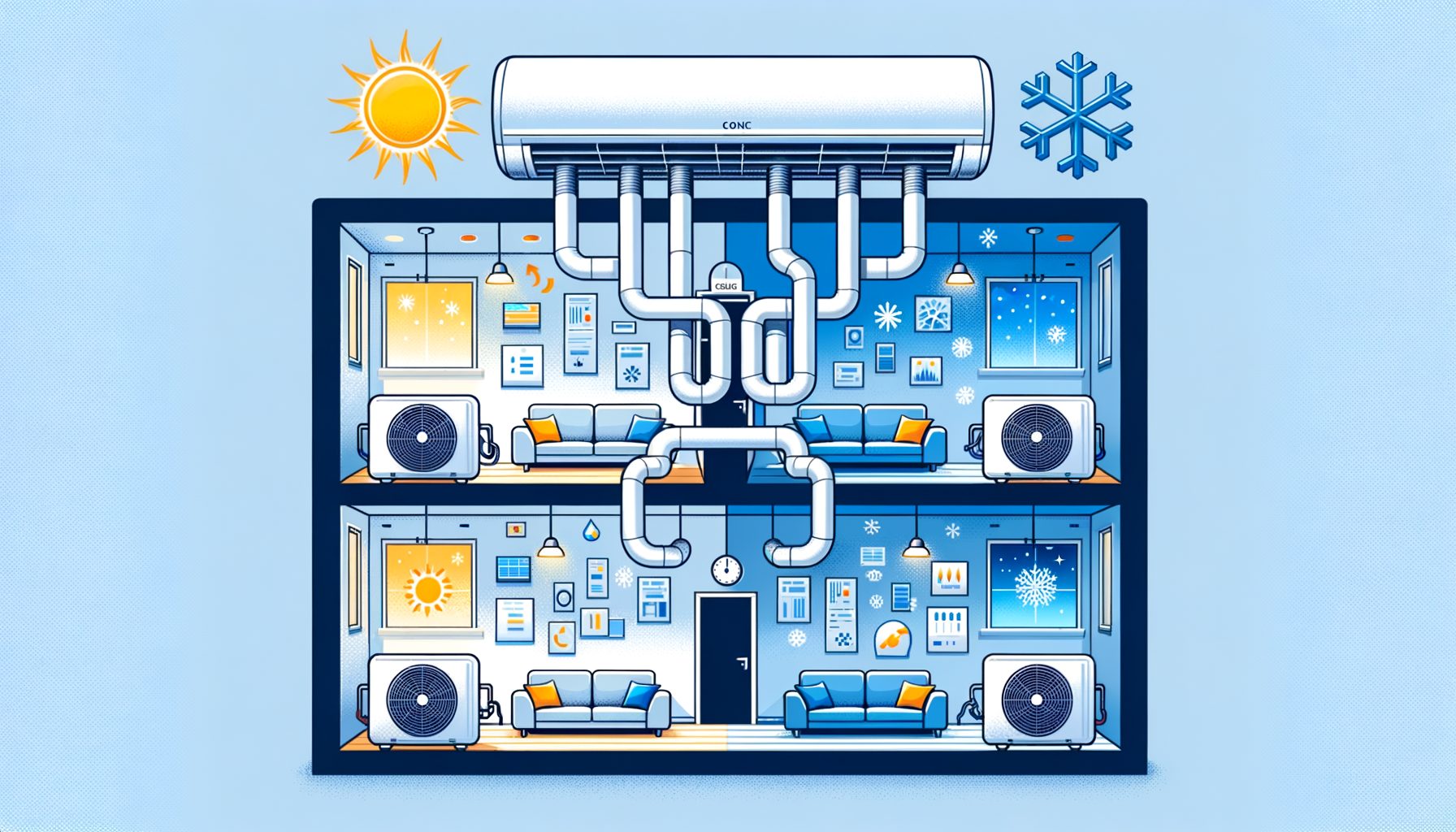
Ducted vs Ductless Air Conditioning tops the list of questions many homeowners and renters ask when summer spikes or energy bills climb. Both systems can cool (and often heat) your space effectively, yet they work differently, feel different, and carry different costs. The core goal is simple: year-round comfort that fits your layout, climate, and budget—without wasting energy. In this guide, you’ll see how each system works, what it costs, how it feels day to day, and how to choose the right option for your situation. By the end, you’ll have a clear, practical roadmap for a confident decision.
What’s the Real Difference? Ducted vs Ductless Explained
Both ducted (also called central air) and ductless (mini-split) systems move heat instead of creating it from scratch. They rely on a heat pump or air-conditioning cycle to expel heat outdoors in summer and, when designed for it, bring heat inside in winter. The key divergence lies in how the conditioned air reaches each room.
Ducted systems push air through hidden ductwork from a central indoor unit to vents throughout the home. It’s a common setup in larger homes and new construction where ducts can be planned into walls, ceilings, or floors. A big visual plus: vents are discreet, and a single thermostat can run the entire home. The trade-off is leakage—typical homes can lose 20%–30% of conditioned air through unsealed ducts—and rooms at the ends of long runs may drift from the setpoint, especially in older homes with undersized ducts. Even so, modern variable-speed central systems paired with well-sealed, insulated ducts can deliver excellent whole-home comfort.
Ductless systems (mini-splits or multi-splits) skip ductwork entirely. An outdoor unit links to one or more compact indoor wall, floor, or ceiling cassettes via refrigerant lines. Each indoor unit governs a “zone,” allowing precise temperature settings per room. Zoning is the ductless superpower: you cool or heat only spaces in use, which reduces waste and often boosts comfort. Without duct losses, these systems frequently achieve higher efficiency ratings. They’re also a retrofit favorite—installers can add climate control to a sunroom, attic, garage conversion, or older apartment without opening walls for ducts.
Day to day, ducted feels seamless and centralized; ductless feels targeted and customizable. If you prefer one dial for the entire home, ducted can be ideal. If different rooms follow different schedules or people want different temperatures, ductless shines. In my experience advising on mixed-humid and hot-dry climate retrofits, the happiest outcomes come from matching technology to the building: central air for tight, well-ducted homes or new builds; mini-splits for retrofits, additions, or multi-zone households that value individual control.
Upfront and Ongoing Costs: Installation, Efficiency, and Bills
Total cost extends beyond day-one price. You’re paying for installation, energy, maintenance, and lifespan. Where ducts already exist and are in good shape, ducted systems can be cost-effective. New ductwork raises costs and complexity, particularly in older buildings where routing space is tight. Ductless installs tend to go faster—especially for single rooms or small apartments—though multi-zone setups can approach central-system prices as you add indoor heads and longer line runs.
Efficiency ratings help compare long-term operating costs. In North America, you’ll see SEER2 for cooling and HSPF2 for heating; elsewhere, EER/IEER for cooling and SCOP/COP for heating are common. Many ductless systems use inverter-driven compressors that modulate output, trimming cycling losses and boosting real-world efficiency. Central systems increasingly adopt variable-speed and inverter technology as well, narrowing the gap.
Maintenance and reliability matter. Ducted systems need periodic duct inspections, filter changes, and occasional duct sealing. Ductless systems call for regular cleaning of indoor unit filters and coils; neglect here cuts airflow and efficiency. Noise is another cost in comfort terms: ductless indoor units often run at library-like levels, while central systems rely on good duct design and blower quality to stay quiet.
Typical ranges vary by country, brand, and installer quality, but the table below offers a global, high-level snapshot. Always request multiple quotes and a proper load calculation (Manual J/S or regional equivalent) before deciding.
| Factor | Ducted (Central Air/Heat Pump) | Ductless (Mini-Split/Multi-Split) |
|---|---|---|
| Typical Install Cost (USD) | $6,000–$15,000 with existing ducts; $12,000–$25,000+ with new ducts | $2,000–$5,000 per single-zone; $7,000–$18,000 for multi-zone |
| Cooling Efficiency | SEER2 ~14–20 (region-dependent); EER varies by model | SEER2 ~18–30; high EER common thanks to inverter tech |
| Heating Efficiency | HSPF2 ~7.5–9.5; COP ~2.5–3.5 | HSPF2 ~9–11+; COP ~3.0–4.5 (cold-climate models available) |
| Indoor Noise | Depends on duct design and blower; 40–55 dB typical at registers | Very quiet cassettes; often 19–45 dB at low/medium fan |
| Lifespan | 15–20 years with maintenance | 12–18 years with maintenance |
| Installation Time | 1–5 days (more with new ducts) | 4–10 hours for single-zone; 1–3 days for multi-zone |
| Best Use Case | Whole-home comfort with existing ductwork | Retrofits, additions, zoning for different rooms/schedules |
As you compare bids, look for right-sizing. Oversized units short-cycle, waste energy, and wear out sooner. Whether you choose ducted or ductless, the best system is the one correctly sized and commissioned for your home. For deeper guidance on efficiency metrics, see ENERGY STAR’s heat pump overview: ENERGY STAR: Air-Source Heat Pumps and the U.S. Department of Energy: Energy Saver: Central Air Conditioning and Energy Saver: Ductless Mini-Splits.
Comfort, Air Quality, and Noise: Everyday Experience
Comfort isn’t just about temperature; it also includes air mixing, humidity, airflow, and sound. Ducted systems move larger volumes of air and can pair with whole-home dehumidifiers and high-MERV filters—great in humid climates and for allergy sufferers. When ducts are designed well—correct trunk sizes, adequate return paths, balanced supply registers—rooms feel even and humidity stays in check. Poorly designed ducts, by contrast, can create hot and cold spots or noisy vents, and dust can accumulate if filters aren’t maintained.
Ductless systems offer pinpoint control. Set your bedroom to 22°C (72°F) while keeping the living room warmer or cooler. That level of zoning is powerful if schedules vary or certain rooms are used only part of the day. Many mini-splits add strong dehumidification modes, and because the air handler sits in the room, you feel the effect quickly. Filtration is typically good but localized: each indoor head has its own filter. If you need advanced filtration for the entire home, you may combine ductless with a standalone purifier or a balanced ventilation system like ERV/HRV.
Noise often gets overlooked. Modern ductless units can be whisper-quiet, especially at low fan speeds—more a soft airflow than a loud blower. Central systems vary: variable-speed blowers and lined ducts can be hushed, but older single-speed systems with metal ducts can transmit sound. If you work from home, sleep lightly, or have a nursery, a well-placed mini-split head is often quieter than a typical central air register. On the flip side, some people prefer not to see wall-mounted heads; in that case, ducted or ducted-mini-split air handlers hidden in ceilings can offer the best of both approaches.
Here’s a real-world example: a family in a 1960s brick townhouse added two ductless zones—one in a top-floor bedroom that overheated in summer and one in a basement playroom that stayed damp. The central system continued to handle the main floor. With the new zones, they nudged the central thermostat slightly higher, dehumidified the basement effectively, and cut electricity use by 18% over the cooling season. Results vary, but targeted zoning often yields both comfort and savings. For background on indoor air quality and ventilation best practices, visit the U.S. EPA’s IAQ resources: EPA: Indoor Air Quality, and for standards and guidance, see ASHRAE Standards & Guidelines.
Climate, Home Type, and Use Cases: Picking the Right Fit
Climate zone, building type, and how you live should guide the HVAC choice. In hot-humid regions (e.g., Southeast Asia, Gulf Coast USA, coastal Australia), humidity control matters as much as cooling. Ductless systems with “dry” modes or inverter-driven dehumidification excel, while central systems with dedicated dehumidifiers deliver excellent whole-home performance. In hot-dry climates (e.g., parts of India, the Middle East, U.S. Southwest), both systems perform well, and ductless can be more efficient when occupancy is uneven.
In cold climates, consider heat pump capability if you want heating too. Cold-climate mini-splits can deliver useful heat down to -15°C to -25°C (5°F to -13°F) or lower by model, often replacing resistance electric heat. Central heat pumps with variable-speed compressors also shine in shoulder seasons, and paired with a backup system (high-efficiency gas or electric resistance), they can handle deep cold. If ducts and a furnace are already in place, a dual-fuel or heat pump retrofit may be straightforward.
Home type also matters. New construction allows maximum flexibility for ducted layouts that ensure balanced airflow and hidden equipment. For older apartments, condos, or historic homes where opening walls is difficult, ductless mini-splits are usually faster and less invasive. Renters may go with portable or window units for the short term, but for long-term comfort, many landlords choose ductless to avoid major renovations and to provide zone control.
Use case examples:
– Additions and attics: Ductless is usually the easiest path, avoiding long duct runs and pressure imbalances.
– Multi-generational households: Zoning lets each person control their own space—ductless or a zoned ducted system works.
– Open-plan homes: Ducted can deliver even coverage; a ducted mini-split air handler plus a few short ducts creates a solid hybrid.
– All-electric goals: High-efficiency heat pumps (ducted or ductless) support decarbonization, especially when paired with solar.
For macro context on why efficient cooling is becoming critical, the International Energy Agency’s report offers helpful global data: IEA: The Future of Cooling.
Smart Controls, Incentives, and Future-Proofing
Today’s best systems aren’t just efficient; they’re connected and adaptable. Smart thermostats and cloud-linked controls learn your schedule, track energy, and automate comfort. With ducted systems, a smart thermostat and variable-speed equipment can hold steady temperatures while trimming energy use. For ductless, manufacturer apps or third-party Wi‑Fi remotes let you schedule each zone, activate eco modes, and monitor filters. Many platforms also integrate with home assistants for voice control.
Variable-speed compressors (inverters) are central to future-proof performance. Instead of cycling on/off at full blast, they ramp smoothly to match the exact load. The result is steadier comfort (no big temperature swings), lower noise, and less energy waste. Whether you opt for ducted or ductless, prioritize inverter-driven designs and ensure proper commissioning—measured refrigerant charge, verified airflow, and correct static pressure (for ducts). Inconsistent commissioning is a hidden comfort killer.
Public incentives can tilt the cost equation. Many countries and regions offer rebates or tax credits for high-efficiency heat pumps, especially all-electric systems. Check local utility websites or government energy agencies. In the U.S., for instance, programs under the Inflation Reduction Act provide income-based rebates and credits for qualifying heat pumps and weatherization; other countries have similar schemes. Wherever you live, pairing HVAC upgrades with insulation and air sealing often yields the best ROI, allowing a smaller (and cheaper) system to do the job.
Future-proofing also includes refrigerant awareness. Lower-GWP refrigerants are rolling out globally. Ask your installer about the refrigerant type and serviceability. Finally, consider resilience: systems with battery-friendly soft-start inverters and load-shedding controls pair better with backup power and solar. If extreme weather or outages are common, that can be decisive.
To explore product criteria and incentives, start with these resources: ENERGY STAR Heat Pumps and your local energy authority or utility. For U.S.-specific policy updates and electrification guidance, see Energy Saver.
Quick Q&A
Q: Which is cheaper to install: ducted or ductless?
A: If quality ducts already exist, ducted can be cheaper for whole-home coverage. If you’re adding cooling to a single room or lack ducts, ductless is usually faster and more affordable. Multi-zone ductless costs can approach central air as zones increase.
Q: Which is more energy efficient?
A: Ductless mini-splits often have higher efficiency ratings due to inverter technology and no duct losses. However, modern variable-speed central systems can be very efficient, especially with sealed, insulated ducts and proper right-sizing.
Q: What about air quality and filtration?
A: Central systems can use high-MERV whole-home filters and integrate dehumidifiers. Ductless units filter at each indoor head. If you need advanced whole-home filtration, central has an edge; otherwise, ductless plus a standalone purifier works well.
Q: Will a mini-split look odd on my wall?
A: Aesthetics are subjective. Many people don’t mind the slim indoor heads. If you prefer hidden equipment, consider ducted mini-split air handlers or ceiling cassettes for a cleaner look without full ducts.
Q: Can both systems heat my home too?
A: Yes, if you choose heat pump variants. Cold-climate models (both ducted and ductless) can provide reliable heat even in sub-zero temperatures, depending on the model and your home’s insulation.
Conclusion
Choosing between ducted and ductless air conditioning comes down to your home’s layout, climate, and comfort priorities. Ducted systems deliver discreet, whole-home comfort—especially when ducts are well designed and sealed. Ductless systems offer surgical precision: zoning, quiet operation, and strong efficiency without the hassle of ducts. We covered how each system works, typical costs, efficiency ratings, comfort and air quality factors, and how climate and home type influence the best choice. You also saw smart controls, incentives, and future-proof features that protect your investment and enhance everyday comfort.
If you already have quality ductwork and want unified control from a central thermostat, a modern variable-speed central system may fit perfectly. If you’re retrofitting, adding rooms, or aiming for personalized comfort with lower energy waste, ductless mini-splits can be transformative. The smartest next step is to get a professional load calculation and two to three quotes from reputable installers. Ask for right-sizing, commissioning details, and projected operating costs. Compare not just price, but also efficiency, warranty, refrigerant type, and noise levels.
Act now: schedule an energy audit, check local incentives, and request quotes that include both a ducted and a ductless option where feasible. Use the resources linked above—such as Energy Saver, ENERGY STAR, and ASHRAE—to ground your decision in reliable data. With the right design and installation, either system can deliver quiet, efficient, year-round comfort tailored to your life.
Your comfort is worth optimizing today—not next season. Imagine opening your energy bill and seeing the savings while every room feels just right. That’s what a well-chosen, well-installed system can do. So, which side are you leaning toward—ducted for seamless whole-home comfort, or ductless for flexible, zone-based control?
Sources
U.S. Department of Energy: Central Air Conditioning
U.S. Department of Energy: Ductless Mini-Split Heat Pumps
ENERGY STAR: Air-Source Heat Pumps